| The differences between wild populations, fancy guppys and laboratory strains | |
|
Taken from the website : http://hot-server.de/poecilia/e-index.html Thanks to Harald Auer.
|
|
|
Wild populations: |
|
|
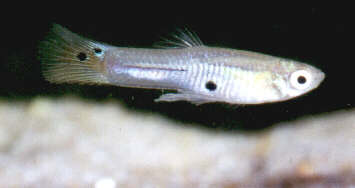
These are guppys living in their natural habitats or descendants of those fish kept in pure bred in captivity. They originate from Venezuela and the southern West Indies. Here they live in various separated populations with a high degree of dimorphism of the secondary sexual coloration of the males.
|
|
|
|
|
|
Trinidad wild population (Prof. Schroeder)
|
|
|
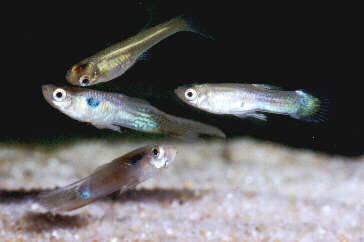
But as early as 1900 guppys were introduced in other tropical or subtropical areas worldwide, mainly in order to help against malaria by controlling the mosquito larvae. In recent time often fancy guppys were introduced in natural habitats. These stocks tend to loose their typical fancy guppy appearance like large colored fins or recessive body colors and soon resemble typical wild guppys after few generations. In countries with cold winters like Germany those populations can only survive in waters that are heated by power plant cooling water in winter.
|
|
|
|
|
|
"Wild animals" from a creek at a power plant near Cologne/Germany (the upper fish is a young female)
|
|
|
Wild guppys are relatively small (male about 2.5 cm / female about 4 cm) and have smaller fins than fancy guppys, but the caudal fin may be slightly elongated. All have a gray general body coloration. The secondary sexual coloration of the males does not cover the whole body, usually they have red, yellow and black spots and configurations on the body and often on the dorsal and caudal fins too. The females of different populations virtually look alike. None of the recessive mutations for xanthic general body coloration or albino has been described in wild populations even in the course of rather extensive search. It seems probable that they have a very definitely negative selective value under natural conditions. (Haskins 1951)
|
|
| Fancy guppys: | |
|
These animals are selected to fulfil designated standards of coloration and fin shape. They have a high degree of domestication and highbreeding, especially the male with delta fins or individuals with pale body coloration would have no chance against predators in the wild. The secondary body coloration of the males should cover very large areas and especially the caudal fin. The body size of fancy guppys is significantly larger than their wild ancestors; this effect is often seen in domestication of animals.
|
|
| Laboratory strain guppys: | |
|
These strains were established decades ago, often only originating in one pair of guppys and have been in pure inbreed (usually random inbreed of the whole stock, more seldom pairings of siblings) ever since.
|
|
|
|
|
|
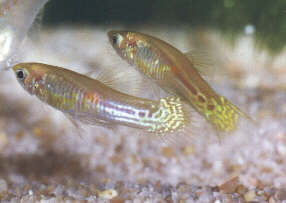
Strain Blond Filigran
|
|
|
All females (with exception of a few strains) have no secondary coloration and do not inherit any color information via their X- chromosome (designated X0) or their autosomes. These old strains are valuable for the science because due to long inbreeding they are nearly isogenic, this means all animals of the stock have nearly the same genetic information (just like strains of laboratory mice). This helps to get reproducible results in genetic or behavioral studies.
|
|